
- Apps
 BYOB ‑ Bundle Gift Box Builder
Build your Own Box
 Easy Bundle ‑ Product Builder
All-In-One bundle builders
 Checkout Blocks & Customizer
Checkout Customization
 Qe Slider ‑ Carousel Slider
Elevates Revenue with Slick Slider


 Qe Seasonal Effects & Decor
Add Festive Seasonal Decorations
 Qe Quick Link Redirect
Fix Broken Links Effortlessly
 Qe Frequently Bought Together
Boost Sales with Smart Upsells
 QeApps ‑ Mobile App Builder
No-code Mobile App Builder
 Qe Product Compare
Allowing Shoppers to Compare Items
 Qe Multiship
Ship Items to Multiple Addresses
 Discount Bulk Volume Quantity
Create Custom Product Bundles
 Sticky Cart+ Fly Cart
Add Fly-to-Cart Animations.
 QeCart ‑ Slide Out Cart
Add Dynamic Slide-out cart
 Qe Speechify | Voice Search
Seamless Voice Search Functionality
 Qe FAQ Page & Product FAQs
Customizable Product FAQs
 ATC Button Animation
Add to Cart Button Animations

Explore Our Shopify Apps to Grow Your Store
- Check Our Apps

Imagine a customer walking into your shop, picking up a product, queuing at the till, and then quietly placing it back on the shelf and leaving. No explanation. No complaint. Just gone.
That is what happens thousands of times a day on Shopify stores around the world. And unlike a physical shop, you cannot see it happening. You cannot stop them at the door. You can only look at your analytics the next morning and wonder where the sales went.
Shopify cart abandonment is not a niche problem for struggling stores. It affects every merchant, at every stage of growth, across every product category. The difference between stores that grow and stores that plateau often comes down to one thing: what happens between “Add to Cart” and “Order Confirmed.”
The good news is that most of those lost sales are preventable. But first, you need to understand why they happen.
Why Cart Abandonment Happens: The Psychology Behind It
Cart abandonment is rarely random. It is almost always rooted in a psychological moment where friction, doubt, or hesitation takes over. Here are the primary reasons buyers walk away.
Trust Concerns at Checkout
When a shopper reaches the checkout page, the psychological stakes rise. They are about to hand over their card details, personal information, and trust your brand to deliver. If anything on that page feels uncertain, whether that is an unfamiliar payment provider, a lack of trust signals, or a checkout page that looks generic and unbranded, the brain defaults to caution. Doubt wins, and the tab gets closed.
Unexpected Costs
Nothing breaks buying momentum quite like a surprise. A shopper who expects to pay £45 and suddenly sees £58 at checkout, due to shipping fees, handling charges, or taxes appearing late in the process, feels deceived. Even if they were willing to pay more, the experience of discovering it at the final step creates a sense of distrust.
Cognitive Overload and Decision Fatigue
The modern online shopper is already overwhelmed. When your checkout adds to that by presenting too many steps, unnecessary form fields, or confusing navigation, the brain looks for the easiest option available. Quite often, that means leaving.
Shipping Anxiety
Delivery timelines, return policies, and shipping costs are top-of-mind concerns for most buyers. If this information is not visible or reassuring at checkout, shoppers will pause, second-guess, and often abandon before completing.
Distraction and External Interruptions
A significant portion of abandonment has nothing to do with your store. The shopper’s phone rang. Their child needed attention. A notification pulled them away. These buyers may genuinely intend to return, but without a reason to, many simply forget.
Lack of Urgency
Quick Insight
Cart abandonment is rarely one big objection. It is usually several small hesitations, stacked up, that the checkout never answers.
The Numbers Behind the Problem
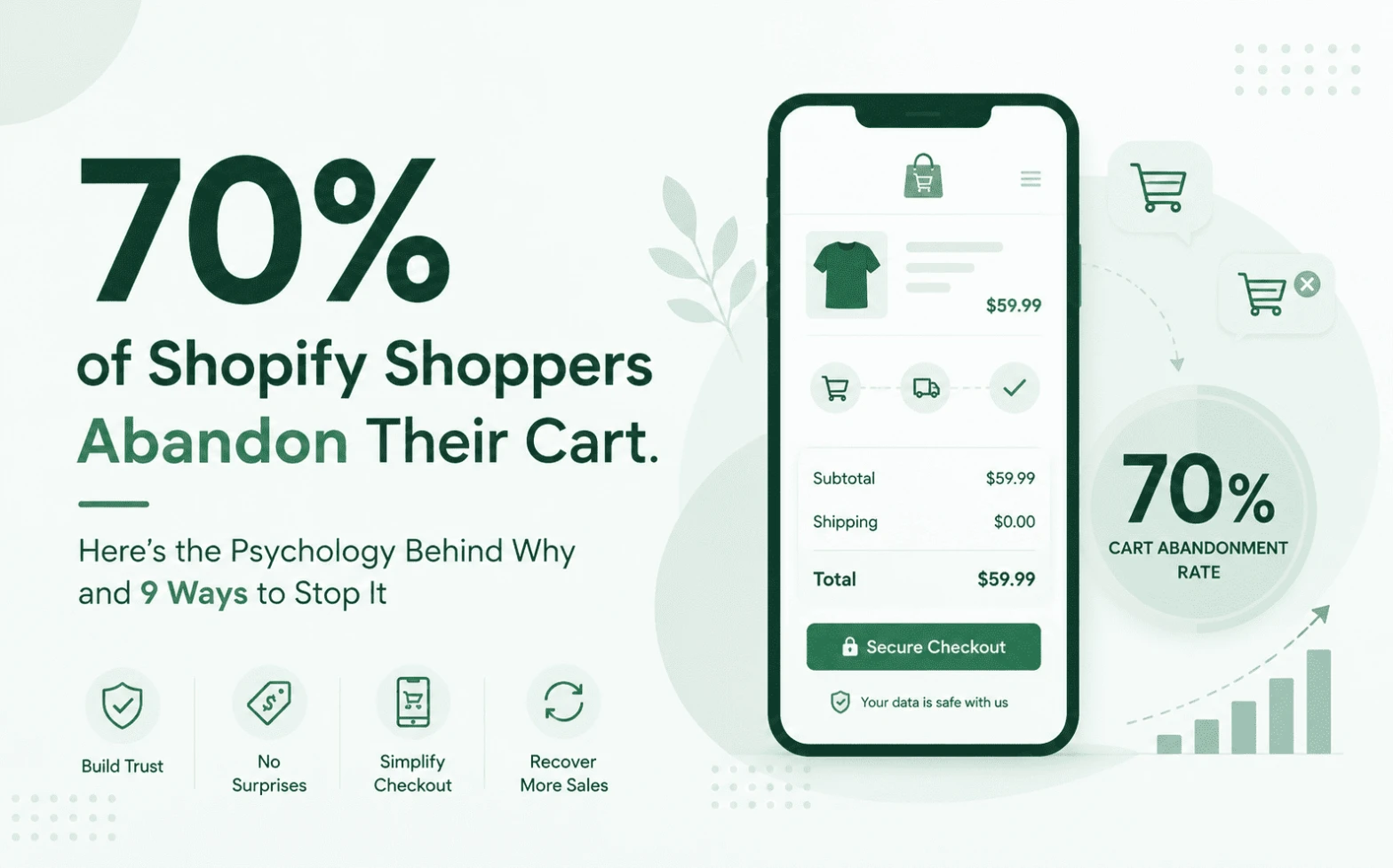
According to the Baymard Institute, the average documented online shopping cart abandonment rate is 70.19%, based on an aggregate of 49 different studies.
That means for every ten shoppers who add a product to their cart, roughly seven leave without buying. For a store turning over £50,000 per month, that is potentially over £100,000 in lost revenue sitting untouched in abandoned carts.
It gets worse on mobile. According to Dynamic Yield’s 2025 data, mobile cart abandonment sits at 80.02%, compared to 66.41% on desktop. Given that over 60% of ecommerce traffic now comes from mobile devices, a checkout that has not been optimised for smaller screens is quietly bleeding sales every single day.
Quick Insight
If your checkout has not been tested on a phone in the last month, it is worth assuming it is losing more mobile sales than your analytics show.
9 Ways to Reduce Cart Abandonment on Shopify
1. Show All Costs Early
Do not wait until the final checkout screen to reveal shipping fees or taxes. Display an estimated total, including delivery, from the moment a customer views their cart. Transparency builds trust. Surprises destroy it.
2. Add Trust Signals Directly on the Checkout Page
Badges indicating secure payment, SSL encryption, money-back guarantees, and accepted payment logos help reassure buyers at the exact moment they hesitate. These signals do not need to be large. They simply need to be present. Tools like Qe Checkout Blocks & Customizer allow Shopify merchants to add custom trust badges, review snippets, and reassurance messaging directly within the native checkout, without any coding required.
3. Reduce the Number of Form Fields
Every additional field a buyer must complete introduces another opportunity to leave. Audit your checkout form and remove anything that is not essential to completing the order. Guest checkout should always be available as a default option.
4. Display Shipping Information and Return Policies at Checkout
Shoppers should not need to leave your checkout to find out how long delivery takes or what your returns policy is. Include this information clearly within the checkout page itself. A single line such as “Free returns within 30 days” can meaningfully improve confidence at the exact moment it is needed.
5. Use Social Proof at the Point of Purchase
A well-timed review or a note indicating that others have recently purchased the same product can shift hesitation into action. This works particularly well in the checkout, where doubt is highest. Adding a short testimonial or star rating near the payment section reminds the buyer they are making a good decision.

6. Create Gentle Urgency With Stock or Time Indicators
Scarcity messaging, when honest, is effective. Showing that only three units remain or that an offer expires at midnight gives shoppers a genuine reason to act now rather than later. Avoid manufacturing false urgency. Savvy shoppers see through it immediately, and it damages trust.
7. Offer Multiple Payment Methods
Not every shopper wants to pay by card. Offering options including Shop Pay, PayPal, Apple Pay, Google Pay, and buy now pay later options removes financial friction and caters to how different buyers prefer to spend. The fewer barriers to payment, the better.
8. Personalise the Checkout Experience
A generic checkout page misses an opportunity to reinforce your brand and build confidence. Merchants who customise their checkout with on-brand messaging, product-specific reassurance, and relevant upsells create a more cohesive experience that feels considered rather than default. Qe Checkout Blocks & Customizer was built specifically for this. It allows Shopify and Shopify Plus merchants to customise checkout blocks, add custom content, display delivery estimates, and create a branded checkout experience that matches the rest of their store.
9. Send Timely Abandoned Cart Recovery Emails
Automation is your safety net. A well-crafted sequence of recovery emails, sent within one hour, then 24 hours, then 72 hours of abandonment, brings a portion of lost buyers back. The first email should be simple and helpful. The second can include a reminder of what they left behind. The third, if you choose to use one, might include a small incentive such as free shipping.
Quick Insight
A branded checkout does not need to be elaborate. Even one on-brand message at the payment step can be the difference between “this feels safe” and “this feels off.”
Cart Abandonment Causes and Fixes: A Quick Reference
| Cause of Abandonment | Practical Fix |
|---|---|
| Unexpected shipping costs | Show estimated totals early in the buying journey |
| Lack of trust signals | Add secure payment badges and guarantees at checkout |
| Too many form fields | Streamline the form; enable guest checkout |
| Uncertainty about returns | Display return policy within the checkout page |
| No payment flexibility | Add PayPal, Apple Pay, Google Pay, BNPL and other options |
| No urgency to purchase | Use honest stock or time-limited indicators |
| Generic, unbranded checkout | Customise with brand messaging and product reassurance |
| No recovery follow-up | Implement automated abandoned cart email sequences |
| Lack of social proof | Add reviews or purchase indicators near payment |
How Checkout Customisation Improves Conversion
Most Shopify merchants invest heavily in their product pages and homepage but treat the checkout as an afterthought. This is where a substantial amount of revenue quietly disappears.
Research shows that optimising the checkout process can increase conversions by as much as 35.62%. That is not a marginal gain. For most stores, that represents a meaningful shift in monthly revenue without adding a single new visitor.
A customised checkout page reinforces brand identity at the moment of highest purchase intent. It answers the buyer’s final questions before they need to go looking. It creates a consistent end-to-end experience that feels deliberate and professional rather than templated.
Checkout customisation is no longer a feature reserved for enterprise retailers. Shopify’s native checkout editor, combined with apps built specifically for this layer of the funnel, now gives merchants of all sizes the ability to compete on experience, not just product.
Quick Insight
Optimising checkout is one of the few conversion levers that does not require a single extra visitor to pay off.
Where Qe Checkout Blocks & Customizer Fits In
Qe Checkout Blocks & Customizer is a Shopify-native app designed to help merchants take control of their checkout experience without needing a developer.
Merchants use it to add custom content blocks, trust badges, delivery messaging, product upsells, and personalised notes directly within the Shopify checkout. For Shopify Plus merchants, it supports deeper customisations aligned with their brand. For standard Shopify stores, it gives access to meaningful improvements that the default setup simply does not allow.
It works within Shopify’s native checkout editor, meaning everything stays compliant, fast, and stable. There are no workarounds, no hacks, just a cleaner and more considered checkout that works harder for your business.
If you are serious about reducing cart abandonment and improving conversion, the checkout is the right place to start.
Final Thoughts
Cart abandonment is a reality of ecommerce, but it is not inevitable. The merchants who reduce it most effectively are those who understand why buyers hesitate and address those hesitations directly within the buying journey.
Show costs upfront. Build trust visually. Simplify the process. Personalise the experience. Then follow up when buyers do walk away.
The checkout page is the last thing standing between a shopper and a sale. Treat it accordingly.
Explore Qe Checkout Blocks & Customizer or install it directly from the Shopify App Store.
No developer needed. Works with Shopify and Shopify Plus.

Frequently Asked Questions
Q.1 Why do customers abandon carts on Shopify?
The most common causes are unexpected shipping costs, a lack of trust at checkout, too many form fields, limited payment options, and a checkout that feels unfamiliar or unbranded.
Q.2 How can I reduce cart abandonment on Shopify?
Show all costs early, simplify your checkout form, add trust badges, offer multiple payment methods, and follow up with automated recovery emails. Personalising your checkout page also makes a measurable difference.
Q.3 What is the average cart abandonment rate in ecommerce?
The Baymard Institute puts the global average at 70.19%, aggregated from 49 studies. On mobile devices, it rises to over 80%.
Q.4 Can checkout customisation increase conversion rates?
Yes. Research indicates that optimising the checkout process alone can increase conversions by up to 35.62%. Adding trust signals, delivery details, and relevant messaging at checkout reduces hesitation at the highest-intent moment.
Q.5 What causes customers to leave at checkout?
Hidden costs, an unbranded checkout page, uncertainty about delivery or returns, limited payment options, and overly long forms are the leading causes.
Related Blogs



 [email protected]
 +91 95747 42204
 9th Floor, Solitaire Connect, Near Gallops Motors, SG Highway, Ahmedabad, Gujarat 380015


