
- Apps


 Easy Bundle ‑ Product Builder
All-In-One bundle builders
 Qe Slider ‑ Carousel Slider
Elevates Revenue with Slick Slider
 Qe Seasonal Effects & Decor
Add Festive Seasonal Decorations
 Qe Quick Link Redirect
Fix Broken Links Effortlessly
 Qe Frequently Bought Together
Boost Sales with Smart Upsells
 QeApps ‑ Mobile App Builder
No-code Mobile App Builder
 Qe Product Compare
Allowing Shoppers to Compare Items
 Qe Multiship
Ship Items to Multiple Addresses
 Discount Bulk Volume Quantity
Create Custom Product Bundles
 Sticky Cart+ Fly Cart
Add Fly-to-Cart Animations.
 QeCart ‑ Slide Out Cart
Add Dynamic Slide-out cart
 Qe Speechify | Voice Search
Seamless Voice Search Functionality
 Qe FAQ Page & Product FAQs
Customizable Product FAQs
 ATC Button Animation
Add to Cart Button Animations

Explore Our Shopify Apps to Grow Your Store
- Check Our Apps


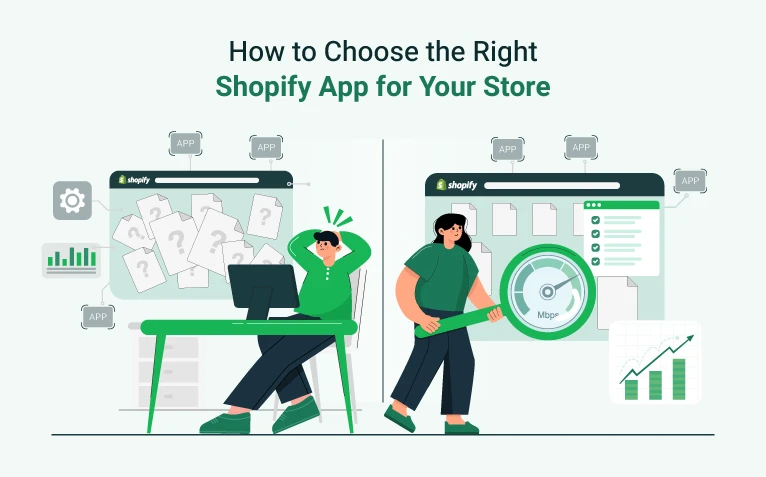
The moment every Shopify store owner reaches
You don’t think much about Shopify apps until the moment you need one.
Something feels slightly off in your Shopify store. Traffic is coming in, but sales aren’t moving the way you expected. Or operations feel heavier than they should. Or growth has slowed, and you’re searching for something, anything, that might help.
So you open the Shopify App Store, That’s when it hits you.
Endless options. Confident promises. Every app claims to be essential. And suddenly, a simple decision turns into hesitation. Because deep down, you know this isn’t just about installing another tool. It’s about choosing something that will quietly shape how your store works every single day.
This is where most Shopify merchants pause. And for good reason.
Why choosing a Shopify app feels overwhelming
On paper, apps are supposed to make life easier. Install, configure, move forward. But in reality, every app becomes part of your store’s foundation.
The wrong app doesn’t always fail loudly. It slows things down quietly. It adds friction where there wasn’t any before. It introduces complexity that builds over time, not overnight.
That’s why learning how to choose the right Shopify app matters more than most people realize. It’s not a technical decision. It’s a business one.
Apps don’t fix confusion inside a Shopify store
One of the most common mistakes Shopify merchants make is searching for apps before understanding the real issue.
Something feels broken, so the instinct is to look for a Shopify app that promises results. But apps don’t replace clarity. If you’re not sure what’s holding your store back, no tool can magically figure it out for you.
Every good app decision starts with awareness. Where does your Shopify store feel weak? Where do customers hesitate? Which part of running the store takes more effort than it should?
When that picture becomes clear, choosing a Shopify app stops feeling random and starts feeling intentional.
The illusion of feature-rich Shopify apps
It’s easy to be impressed by long feature lists.
Automation, Optimization, Customization, Analytics, All bundled into one app.
But more features don’t always mean better results. In many cases, they mean more settings, more scripts, and more complexity. Feature-heavy Shopify apps can be harder to manage and harder to measure. When everything is possible, it becomes difficult to know what’s actually working.
The most effective Shopify apps often do one thing exceptionally well. They don’t demand constant attention. They don’t overwhelm the dashboard. They quietly support the Shopify store without getting in the way.
When Shopify apps start stacking up
No one installs too many apps on purpose.
It happens slowly. One app solves one problem. Another handles a different task. Over time, tools overlap, scripts stack, and the store starts to feel heavier than it once did.
This is when performance issues appear. Pages load slower. Things behave unpredictably. The Shopify store no longer feels as smooth as it used to.
Experienced Shopify merchants eventually learn that fewer, well-chosen Shopify apps usually outperform a crowded setup. Every app should have a clear reason to exist. If its purpose isn’t obvious anymore, it’s worth questioning.
Reading Shopify app reviews with context
Reviews matter, but they’re easy to misread.
A high rating doesn’t guarantee the app will work for your Shopify store. What matters more is who is leaving the review and why. Feedback from stores similar to yours tends to be far more useful than general praise.
Many merchants pay close attention to comments about reliability, updates, and support. When something breaks and eventually, something always does support quality matters more than features.
Shopify app reviews tell a story, but only if you read beyond the stars.
Compatibility issues most people notice too late
Not all Shopify apps integrate smoothly with every theme or setup.
Sometimes the issues are subtle. A layout shift. A button behaving oddly. Other times, they’re serious enough to affect checkout or core functionality. These problems often don’t come from the Shopify store itself, but from how apps interact with each other.
Well-built Shopify apps are transparent about compatibility. They communicate limitations clearly and provide guidance before installation. That transparency is often a sign of maturity and long-term reliability.
Thinking about your Shopify store beyond today
It’s easy to choose apps based on how your store looks right now. But stores change quickly.
An app that feels perfect at low order volumes may struggle as traffic increases. Tools that seem flexible early on can become limiting later. Growth has a way of revealing weaknesses that weren’t visible at the start.
Choosing Shopify apps with scalability in mind helps avoid constant rebuilding. It allows your Shopify store to grow without forcing you to replace tools every few months.
Why free trials matter more than they seem
Free trials are often treated casually, but they reveal more than feature lists ever will.
A trial shows how an app fits into daily workflows. Does it feel intuitive? Does it add clarity or friction? Does managing it feel natural, or does it demand constant attention?
Most Shopify merchants can tell early on whether an app feels right. If something feels heavy during a trial, it rarely becomes lighter later.
Developing a healthier approach to Shopify apps
Over time, successful Shopify merchants change how they think about apps.
They stop chasing trends. They stop installing tools out of curiosity. Instead, they focus on alignment, choosing Shopify apps that support how they operate and how they want their store to grow.
Some merchants prefer individual tools with narrow focus. Others lean toward app ecosystems designed to work together. There’s no single right approach. What matters is that each app earns its place in the Shopify store.
Choosing clarity over quantity
The strongest Shopify stores aren’t powered by dozens of apps. They’re powered by clear decisions.
Learning how to choose the right Shopify app means understanding your store well enough to recognize what genuinely helps and what simply adds noise. When apps are chosen with intention, they don’t feel like add-ons. They feel like natural extensions of the store itself.
In a crowded Shopify App Store, clarity becomes a real advantage.
Related Blogs






 [email protected]
 +91 95747 42204
 9th Floor, Solitaire Connect, Near Gallops Motors, SG Highway, Ahmedabad, Gujarat 380015


