
- Apps


 Easy Bundle ‑ Product Builder
All-In-One bundle builders
 Qe Slider ‑ Carousel Slider
Elevates Revenue with Slick Slider
 Qe Seasonal Effects & Decor
Add Festive Seasonal Decorations
 Qe Quick Link Redirect
Fix Broken Links Effortlessly
 Qe Frequently Bought Together
Boost Sales with Smart Upsells
 QeApps ‑ Mobile App Builder
No-code Mobile App Builder
 Qe Product Compare
Allowing Shoppers to Compare Items
 Qe Multiship
Ship Items to Multiple Addresses
 Discount Bulk Volume Quantity
Create Custom Product Bundles
 Sticky Cart+ Fly Cart
Add Fly-to-Cart Animations.
 QeCart ‑ Slide Out Cart
Add Dynamic Slide-out cart
 Qe Speechify | Voice Search
Seamless Voice Search Functionality
 Qe FAQ Page & Product FAQs
Customizable Product FAQs
 ATC Button Animation
Add to Cart Button Animations

Explore Our Shopify Apps to Grow Your Store
- Check Our Apps


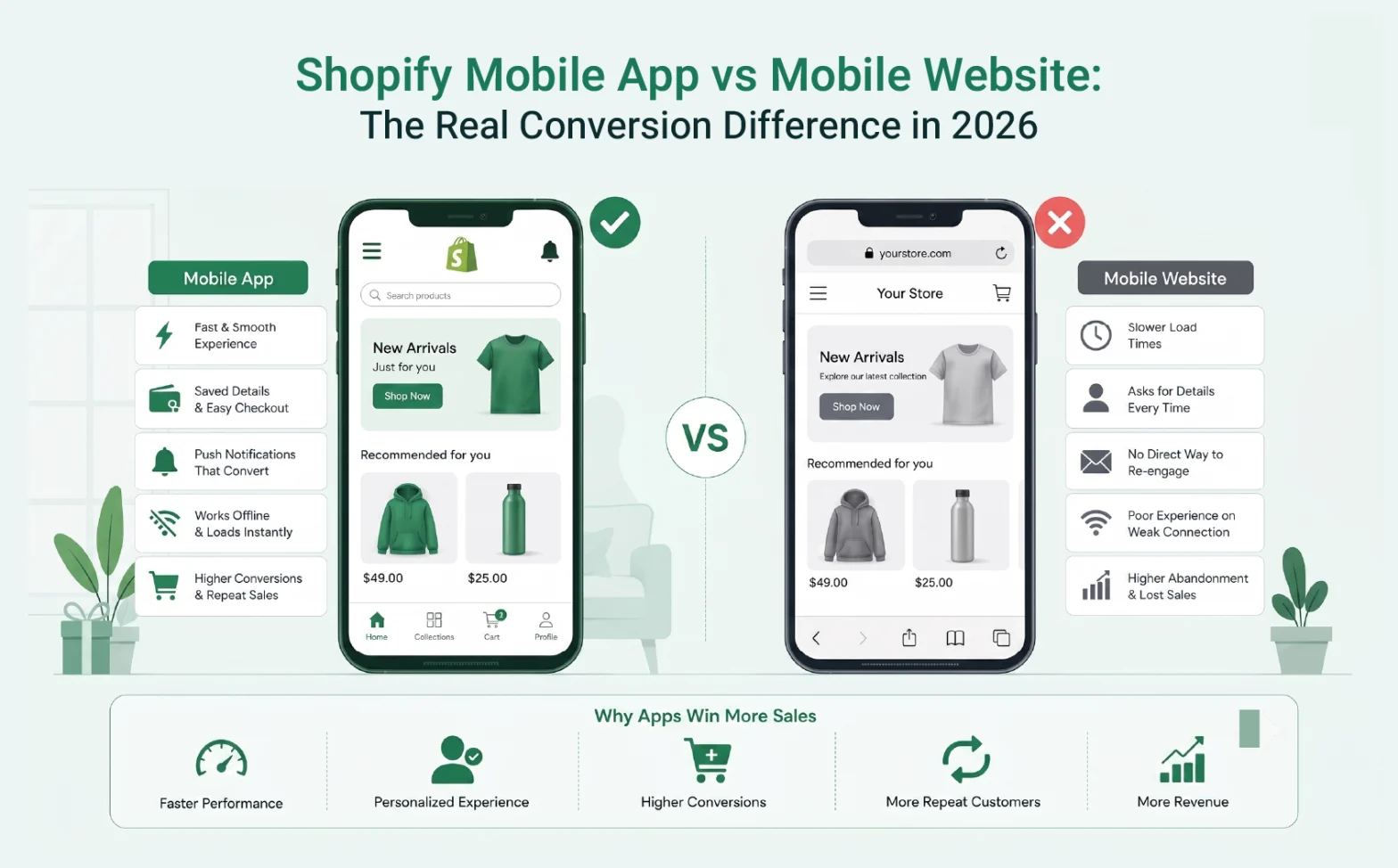
Most Shopify stores get more traffic from mobile than desktop now. Very few get more sales from it. That gap has nothing to do with how your site looks on a phone. It comes down to what a browser can offer a shopper versus what a native app can offer them, and the difference is bigger than most merchants assume.
This article breaks down where the Shopify mobile app vs mobile website gap actually comes from, what changes for a shopper once they have your app instead of your website, and how to work out if building one makes sense for your store.
Does a Mobile App Convert Better Than a Mobile Website?
In most cases, yes. A native app cuts out the two biggest reasons mobile checkouts stall: slow reloads and a checkout that forgets the customer every time they come back. A mobile website still does its job well for first-time visitors coming from search or social. It is not built to bring the same shopper back again and again, and that repeat business is where a large share of Shopify revenue comes from.
Why Mobile Traffic and Mobile Sales Don’t Match Up
Mobile phones now drive around 75 to 77 percent of all retail site traffic worldwide, according to Statista’s device-level data on ecommerce visits. That number has been climbing for years and shows no sign of slowing down. Your conversion rate on that traffic has probably not climbed at the same pace.
That is not because mobile shoppers care less about buying. It is because a website has to reload almost every time a customer taps something, rarely remembers their card details unless they saved them, and usually loses their cart the moment they close the tab. No redesign fixes that. It is simply how a browser works.
Cart abandonment shows the size of the problem clearly. Baymard Institute looked at 50 separate studies and found an average cart abandonment rate of 70.22 percent, with mobile running higher than that average, not lower. In plain terms, for every 10 shoppers who add something to their cart on mobile, roughly 7 leave without paying. That is lost revenue sitting in plain sight on your own analytics dashboard.
What Actually Changes When a Shopper Has Your App Instead of Your Website
A website only exists for a customer during that one visit. An app stays on their phone, and that changes the shopping experience in a few concrete ways.
Pages load faster: An app keeps a lot of its data stored on the phone instead of pulling a fresh page from a server every time. On a weak signal, that is often the difference between a shopper browsing five more products or giving up.
The app remembers the customer: Saved payment details, a cart that is still there three days later, and no need to log in again. Every field a returning shopper does not have to fill in again is one less reason for them to drop off before paying.
You can reach them after they leave: This is the one thing a website cannot do. A push notification about a restock or an item still sitting in their cart lands right on their phone. An abandoned cart email has to compete with dozens of other emails in the same inbox.
Browsing still works with a weak connection: A shopper scrolling your catalogue on a train or somewhere with patchy signal can still see what is already loaded in the app. On the website, the page simply stops loading.
None of this means your website stops mattering. A first-time visitor from a Google search or an Instagram post is still going to land on a page, not an app they have never installed. The website is still how you win new customers. The app is where you stop losing the ones who already liked what they saw.
Mobile Website vs Native App: Side by Side
| What matters at checkout | Mobile Website | Native Mobile App |
| First-time visitor access | Instant, no download needed | Needs a download before first use |
| Returning visitor experience | Reloads and asks for details again | Opens straight to a saved cart and account |
| Reaching a shopper after they leave | Email or SMS only | Push notification, direct to their phone |
| Checkout on a weak connection | Often stalls or times out | Keeps working using stored data |
| Browsing with no signal | Not possible | Still works with cached pages |
| Cost and setup | Already in place on your store | A dedicated builder, usually days, not months |
A Scenario Worth Recognising
Say you run a mid-sized apparel store. Desktop sells well. Mobile brings in most of your traffic, and most of your abandoned carts too. You already have an abandoned cart email set up. It recovers a few orders a week, well short of what your abandonment numbers suggest you are losing.
The email is not the problem. It is arriving in a channel your customer does not check with much urgency. A push notification about the same jacket, sent straight to the phone they are already holding, reaches them far closer to the moment they were actually interested. That is the specific gap a native app closes, not some general claim that apps are simply better.
Where Merchants Usually Get This Wrong
The costliest mistake is building a full custom app before knowing whether customers actually want one. A progressive web app or a no-code builder lets you test that demand for a fraction of the cost, and for most stores, that is all you need.
The second mistake is launching an app and leaving checkout exactly as it was on the website. If the app just carries over the same cluttered checkout, the friction is still there. Pairing a new app with a tighter checkout flow tends to move the needle more than either change on its own.
The third is treating push notifications like a second email list. A back-in-stock alert or a cart reminder gets read. A daily promotional push is one of the fastest ways to get your app uninstalled.
What to Check Before You Build Anything
Compare your mobile cart abandonment rate to your desktop rate before spending anything on an app. If mobile runs noticeably higher, which is true for most Shopify stores, that gap is your business case, not a guess.
Keep the app’s first-time setup short. A customer asked to create a full account before browsing a single product is likely to close the app before they see anything worth buying.
Keep the app and website in sync in real time. Stock, pricing, and order history should look the same no matter which one a customer happens to open.
Why You Shouldn’t Wait Too Long
Building a native app used to be something only large retailers could afford. No-code builders have brought that cost down enough that small and mid-sized Shopify stores can launch one properly, not just enterprise brands with in-house developers. As more stores in the same category close this gap, the ones still relying on a website alone are likely to keep losing repeat customers to whoever got onto that customer’s home screen first.
Bringing It Together
Your mobile website is not the problem, and it is not going anywhere. It is still how most new customers find you for the first time. The gap shows up later, with shoppers who already liked what they saw and still did not come back to pay.
A native app closes that specific gap: fewer reloads, a checkout that remembers the customer, and a direct way to reach them after they leave. QeApps Mobile App Builder lets Shopify merchants set this up without hiring a developer, with real-time sync to your existing store and push notifications built in from the start.
Have a look at the builder on the QeApps website, or install it directly from the Shopify App Store and see how it changes your own numbers.
Frequently Asked Questions
Q.1 Does a mobile app really convert better than a mobile website?
Yes, in most cases. Apps remove the friction that causes mobile checkout to stall, and they give you a direct way to reach shoppers that a website does not have.
Q.2 Is this only worth it for large Shopify stores?
No. No-code app builders have made native apps affordable for small and mid-sized stores, not just brands with an in-house development team.
Q.3 Should a mobile app replace my website?
No. Keep both. The website still brings in first-time visitors from search and social. The app is where returning customers and recovered carts actually convert.
Q.4 What is the difference between a PWA and a native app?
A progressive web app runs in the browser but behaves like an app. A native app is downloaded from the App Store or Google Play and usually supports deeper push notifications and offline browsing.
Q.5 Can a small store really compete with bigger brands that already have an app?
Yes. Push notifications, a faster checkout, and app store presence are available at any store size once the builder is in place, not just for brands with big development budgets.
Related Blogs





 [email protected]
 +91 95747 42204
 9th Floor, Solitaire Connect, Near Gallops Motors, SG Highway, Ahmedabad, Gujarat 380015


