
- Apps

 Easy Bundle ‑ Product Builder
All-In-One bundle builders

 Qe Slider ‑ Carousel Slider
Elevates Revenue with Slick Slider


 Qe Seasonal Effects & Decor
Add Festive Seasonal Decorations
 Qe Quick Link Redirect
Fix Broken Links Effortlessly
 Qe Frequently Bought Together
Boost Sales with Smart Upsells
 QeApps ‑ Mobile App Builder
No-code Mobile App Builder
 Qe Product Compare
Allowing Shoppers to Compare Items
 Qe Multiship
Ship Items to Multiple Addresses
 Discount Bulk Volume Quantity
Create Custom Product Bundles
 Sticky Cart+ Fly Cart
Add Fly-to-Cart Animations.
 QeCart ‑ Slide Out Cart
Add Dynamic Slide-out cart
 Qe Speechify | Voice Search
Seamless Voice Search Functionality
 Qe FAQ Page & Product FAQs
Customizable Product FAQs
 ATC Button Animation
Add to Cart Button Animations

Explore Our Shopify Apps to Grow Your Store
- Check Our Apps

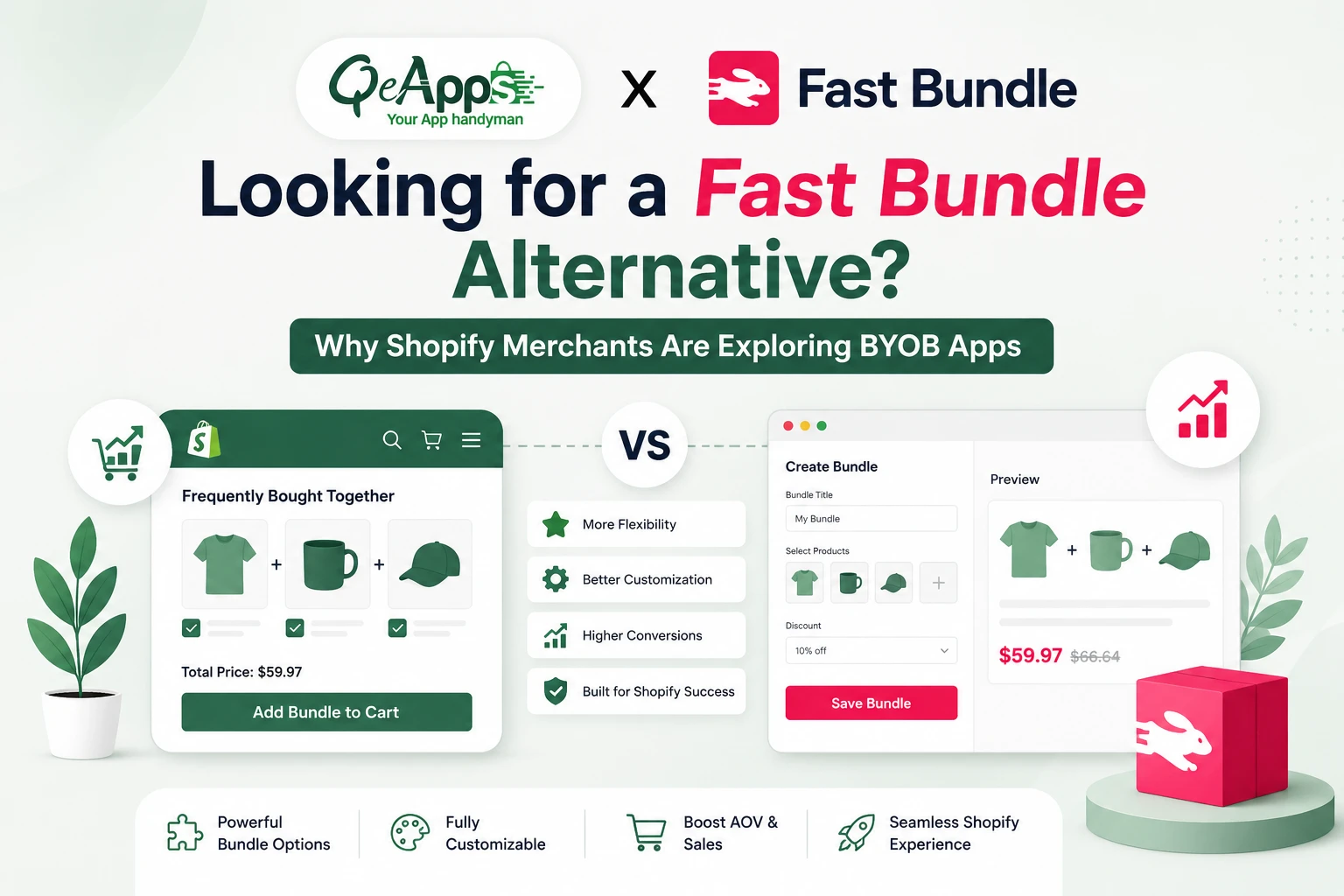
Choosing a Shopify bundle app looks like a features decision. It isn’t. It’s a decision about how your customers want to shop – and the merchants who get this right pick the app that matches that behaviour, not the one with the longest feature list.
That question has become more urgent recently. Fast Bundle, one of the more established bundling apps on Shopify, is currently going through a review process and its official App Store listing is temporarily unavailable. For stores mid-campaign or mid-migration, that’s forced a decision that might otherwise have waited. If you’ve landed here searching for an alternative, you’re not looking for a lecture on bundle theory – you want to know what to do next.
The useful part: the answer depends less on which app is “best” and more on what kind of bundle experience your store actually runs. Get that clear, and the choice narrows on its own.
Two different jobs get called “bundling”
Almost every bundle app on Shopify sits somewhere on a spectrum between two very different jobs.
The first is the merchant-defined bundle: you decide what goes in it, you set the price, and the customer clicks add. Fixed sets, buy-one-get-one, quantity breaks, frequently bought together, volume discounts, post-purchase upsells. The customer is choosing to accept a deal you’ve built.
The second is the customer-built bundle: you set the rules – categories, minimum items, pricing logic – and the customer assembles the box themselves. Build Your Own Box (BYOB), mix-and-match sets, curated selections where the choosing is part of the appeal.
These read as variations on the same idea. In practice, they’re different products. A skincare brand offering a fixed “starter kit” is running a promotional bundle. A skincare brand letting shoppers pick their own cleanser, serum and moisturiser is running a guided builder. Both work. Neither is universally right. But an app optimised for the first job will feel clumsy at the second, and vice versa.
Fast Bundle has historically covered both sides, which is part of why merchants leaned on it. When you’re looking at replacements, the first useful move is to notice which side of that line your bundles actually live on. Most stores have a clear centre of gravity even if they run a mix.
When customer-built is the whole point
There’s a category of Shopify store where the act of choosing isn’t a step in the funnel – it’s part of the product.
Gift box brands. Chocolate makers. Coffee and tea sellers. Skincare and self-care. Snack boxes, jewellery collections, curated wellness kits, hampers. In these stores, the customer isn’t looking for a discount on a set someone else put together. They’re building something for a specific person, a specific occasion, a specific routine. The bundle is the gift, and choosing is the fun of it.
For those stores, a Build Your Own Box app isn’t a nice-to-have Fast Bundle app alternatives to a promotional bundle tool. It’s the correct product, and a general bundle app will always feel like it’s simulating the experience rather than delivering it.
The tell is usually in how customers ask. “Can I pick what goes in it?” If that’s the question you get in DMs, on live chat, or from your top-of-funnel ads, your store is a BYOB store. Fixed bundles will convert, but they’ll leave a specific kind of buyer disappointed – the one who came because they wanted to make something.
Where Qe BYOB fits
Qe BYOB – Bundle Gift Box Builder is built specifically for that second job: guided, customer-built box experiences on Shopify. It handles the parts that separate a real builder from a set of stitched-together product options.
Customers move through a multi-step flow you define – choose a box, pick products, add personalisation, review, add to cart. Pricing can be fixed, tiered, quantity-based, or a percentage discount off the total. You can add gift notes, product personalisation, even audio and video messages to the finished box. The builder can live on product pages or its own dedicated page, matched to your theme so it feels native rather than bolted on. Multi-language and multi-currency are supported for stores selling across regions.
Around 10,000 Shopify stores use it, including gifting-first brands like Baiabox, Hug in a Box, and Cosy Cottage. It carries Shopify’s Built for Shopify badge and a 5.0 rating across 300+ reviews. Support is human, with 1:1 onboarding on paid plans and a dedicated success manager on Enterprise – the kind of thing that matters more than it sounds when you’re rebuilding bundles under time pressure.
That’s the case for it, stated plainly. It doesn’t try to be every bundle tool. It’s built for one job and does that job at depth. If your store’s bundle experience is customer-built, that focus is the reason to look at it.
When something else is the better answer
If your bundling is mostly fixed sets, volume discounts, or post-purchase upsells, a BYOB-focused app isn’t your primary tool – a general bundle app will fit that better. The wider QeApps suite covers the adjacent jobs (Frequently Bought Together, Easy Bundle, volume discounts, cart and checkout upsells), so those pieces can sit alongside Qe BYOB when your store runs both kinds of offers. Being clear about which job is the centre saves you from picking a tool for the edge case and finding it awkward at the main event.
A short checklist before you switch
Five minutes on these will save you an hour of untangling later.
Identify the centre of gravity. Look at the last 90 days of bundle revenue. Is it coming from fixed sets and quantity breaks, or from customers building their own? Whichever line is larger tells you which tool matters most.
Test the buying path on your current setup. Whether Fast Bundle is unavailable in your region or your existing app is simply underdelivering, walk every bundle page, add-to-cart, discount, and checkout on mobile and desktop. Note what’s actually broken before you decide what to replace.
Duplicate your theme before you touch anything. Backups are cheaper than recovery.
Rebuild, don’t migrate. Bundle configurations don’t transfer between different apps. Any replacement means recreating your builders in the new tool. Factor that time in, and use onboarding help if it’s offered.
Test a full order before re-pointing ads. Broken bundle URLs draining ad spend is the most expensive part of any transition.
The question at the front of all of this is the one worth ending on. Not “which bundle app has the most features” – every serious app in this category has a long list. The real question is which app matches how your customers actually want to shop.
If your customers want a curated deal, pick a promotional bundle tool. If they want to make something themselves, pick a builder built for that.
For merchants on the second side of that line, Qe BYOB is a straightforward answer. The 14-day free trial is the fastest way to see whether it fits.
Frequently asked questions
Is Fast Bundle currently available on Shopify?
Fast Bundle’s official website states that its App Store listing is temporarily unavailable while it completes Shopify’s review process. Check the App Store directly for the latest status.
What’s the best Fast Bundle alternative for my store?
It depends on which bundle job your store actually runs. For fixed sets, promotional bundles, or upsells, compare general bundle apps by the specific features you use. For customer-built boxes and gift bundles, a specialised builder like Qe BYOB is a closer match.
What does BYOB mean, and how is it different from a regular bundle?
BYOB – Build Your Own Bundle – lets customers assemble their own combination within rules you define, rather than buying a pre-built set. Regular bundles are chosen by the merchant; BYOB puts the choosing in the customer’s hands, which suits gifting, personalisation and curated-box businesses.
Can I use Qe BYOB to create gift boxes?
Yes. Gift-box building is one of its core use cases, including gift notes, product personalisation, and audio or video messages attached to the finished box.
Will my existing bundles transfer if I switch apps?
No. Bundle configurations never transfer automatically between different apps. You rebuild them in the new tool. Qe BYOB offers 1:1 onboarding on paid plans to make that quicker.
Related Blogs



 [email protected]
 +91 95747 42204
 9th Floor, Solitaire Connect, Near Gallops Motors, SG Highway, Ahmedabad, Gujarat 380015


