
- Apps
 BYOB ‑ Bundle Gift Box Builder
Build your Own Box
 Easy Bundle ‑ Product Builder
All-In-One bundle builders
 Checkout Blocks & Customizer
Checkout Customization
 Qe Slider ‑ Carousel Slider
Elevates Revenue with Slick Slider


 Qe Seasonal Effects & Decor
Add Festive Seasonal Decorations
 Qe Quick Link Redirect
Fix Broken Links Effortlessly
 Qe Frequently Bought Together
Boost Sales with Smart Upsells
 QeApps ‑ Mobile App Builder
No-code Mobile App Builder
 Qe Product Compare
Allowing Shoppers to Compare Items
 Qe Multiship
Ship Items to Multiple Addresses
 Discount Bulk Volume Quantity
Create Custom Product Bundles
 Sticky Cart+ Fly Cart
Add Fly-to-Cart Animations.
 QeCart ‑ Slide Out Cart
Add Dynamic Slide-out cart
 Qe Speechify | Voice Search
Seamless Voice Search Functionality
 Qe FAQ Page & Product FAQs
Customizable Product FAQs
 ATC Button Animation
Add to Cart Button Animations

Explore Our Shopify Apps to Grow Your Store
- Check Our Apps

Picture this. A customer lands on your Shopify store looking for a birthday gift. They don’t want just a single candle or a lone bottle of moisturiser. They want to build something, something that feels chosen, not grabbed off a shelf. So they browse your collection pages, try to piece it together manually, can’t quite make it work, and leave.
No sale. No return visit. Just a lost customer who was already ready to spend.
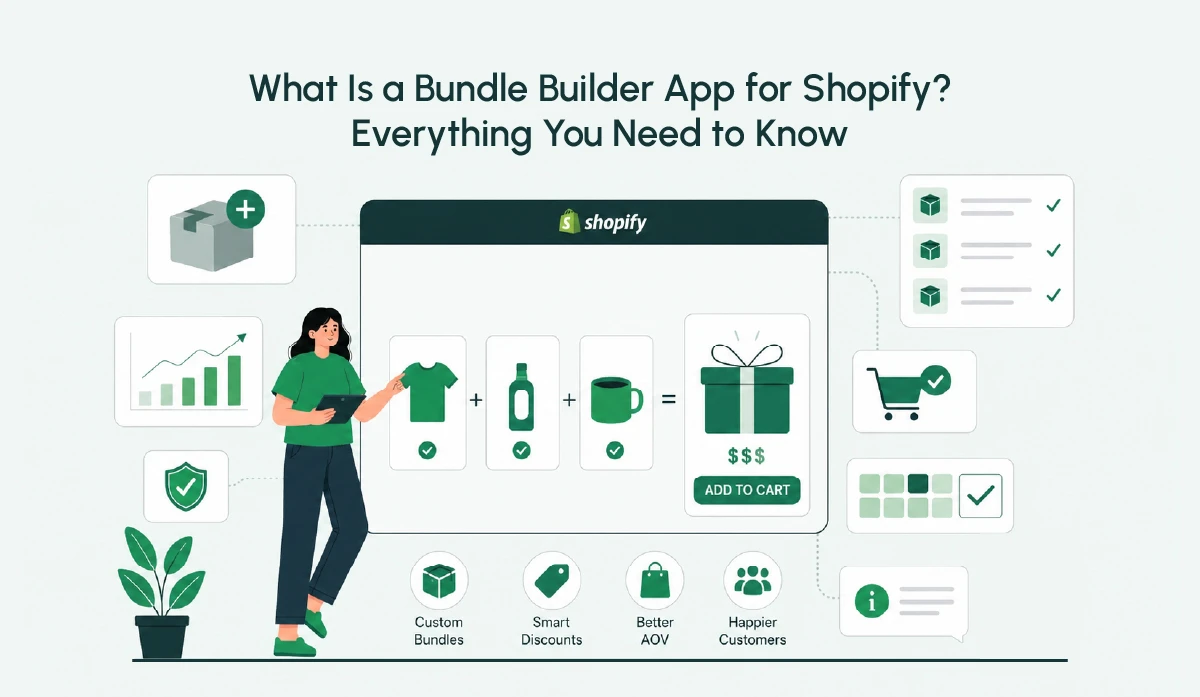
This happens every single day on stores that haven’t yet cracked product bundling on Shopify. And the solution isn’t a complete store redesign or a developer on retainer. It’s a Bundle Builder App for Shopify, a tool that lets your customers build exactly what they want while you set the rules.
This guide covers everything a merchant needs to understand: what these apps actually do, how the experience works for both the shopper and the store owner, what to look for before you install one, and who should be prioritising this right now.
So What Exactly Is a Bundle Builder App?
At its simplest, a Bundle Builder App for Shopify lets customers assemble their own product combinations directly on your storefront. They pick the items, choose the quantities, and customise their selection, all within a guided experience that you’ve designed and configured.
That’s meaningfully different from a standard product bundle, which is just a fixed set of products grouped together. A bundle builder is interactive. The customer is doing the choosing. Your logic determines the constraints, how many items, which categories are available, whether pricing is fixed or dynamic, and what discount kicks in at what threshold.
And that distinction matters more than it might seem. When customers build something themselves, they feel ownership over it. They arrive at checkout not just buying a product but buying their version of it. That shift in psychology is a large part of why build-your-own-bundle experiences consistently outperform static product pages on both average order value and checkout completion.
Why Are Shopify Merchants Prioritising This Now?
The numbers are hard to argue with. Product bundles increase average order value by 20–35% on average, with the strongest implementations reaching 55% lifts. Customers who purchase bundles also show 2.7x higher lifetime value than single-item buyers, so the payoff isn’t just on the first order.
The average Shopify store runs an order value of around $85. The top 10% of merchants sustain AOVs above $326. Strategic bundling is consistently one of the tactics separating those two groups.
Beyond the data, there’s a simpler truth: the way people shop for gifts, build routines, and discover products has changed. They want to curate, not just select. They want choice within a structure, not an overwhelming product grid. A bundle builder gives them exactly that.
How Does the Customer Experience Actually Work?
Let’s walk through the experience from both sides of the counter.
What the customer sees
Step 1: Choosing the bundle type or box: The customer starts by picking a bundle framework, perhaps a gift box of five items, a skincare routine builder, or a “Pick Any 4” food hamper. The structure is set by you; the contents are chosen by them.
Step 2: Browsing and selecting products: They scroll through eligible products, with filters, categories, and search to help navigate a large catalogue. Multi-step builders, like those available in QeApps BYOB, guide customers through different product types in sequence. Skincare step one: choose your cleanser. Step two: choose your toner. Step three: choose your moisturiser. The flow removes decision fatigue and keeps shoppers engaged.
Step 3: Adding personalisation: This is where gifting experiences genuinely stand apart. Advanced bundle builders let customers attach a written message, upload an image, or even record an audio or video gift note. That’s not a gimmick; it’s the difference between a gift box and a personal gift box.
Step 4: Seeing the price update in real time: As items are added, the price updates dynamically. If a quantity-based discount applies, say, 10% off when all five slots are filled, it kicks in automatically. The completed bundle goes to cart as a single line item, keeping checkout clean and straightforward.
What you manage on the back end
You configure the rules: which products are eligible, minimum and maximum selections per bundle, whether pricing is fixed or item-by-item, and which discount tiers apply at which thresholds. Inventory management runs automatically in well-built apps; stock decrements in real time across every variant included in a bundle order, eliminating the overselling risk that catches merchants off guard.
What Separates a Good Bundle App from a Frustrating One?
Not every Shopify bundle app is built to the same standard, and the differences become obvious quickly once you’re in setup or, worse, once orders start coming in. Here’s what to evaluate before you commit.
- Theme compatibility without custom code: The builder should sit cleanly inside your existing store, including Online Store 2.0 themes, without needing a developer. If the free trial requires custom work just to look presentable, that tells you something about the ongoing maintenance cost.
- Pricing flexibility: Fixed-price builders suit standardised gift sets. Dynamic pricing suits variable mix-and-match selections. Tiered discounts suit volume-based incentives. A bundle builder worth using should handle all three, because your needs will evolve.
- Inventory synchronisation: This is non-negotiable. Every order must accurately reduce stock across all included variants, instantly, with no reconciliation required afterwards. Apps that handle this inconsistently create real operational problems at scale.
- Mobile experience: Nearly 79% of Shopify store traffic arrives on mobile, but only 68% of transactions are completed there, a gap that poor mobile UX makes significantly worse.
- A bundle builder that’s awkward on a phone will quietly lose conversions you’ll never see in your analytics.
- Analytics that tell you something useful: You need to know which bundles are converting, which products get added most frequently, and where customers are dropping out of the flow. Without that data, optimisation is guesswork.
- Support that’s actually there: Setup questions will come up. Configuration edge cases will appear. The difference between an app with real human support and one with a help centre and a ticket queue becomes apparent quickly when something needs fixing.
Finding the Right App: What QeApps BYOB Gets Right
When you apply those criteria to the Shopify App Store, QeApps BYOB – Bundle Gift Box Builder holds up well across all of them.
It supports fixed-price, mix-and-match, and discounted bundle types, as well as multi-step builders that walk customers through product selection in sequence. Personalisation options include custom text, image uploads, and audio or video gift messages, which makes it a strong fit for gifting-led stores. Multi-language and multi-currency support is built in for merchants selling internationally.
The app works across all Shopify themes without coding, comes with real-time analytics at the higher tier, and has a 4.9-star rating on the Shopify App Store from over 300 reviews across 10,000+ merchants. Merchant feedback consistently highlights the quality of support, not just the feature set.
Plans start from $19/month with a 14-day free trial, making it accessible from early-stage stores through to established DTC brands.
Which Stores Should Make This a Priority?
Gifting and occasion-led retailers: If any meaningful share of your revenue comes from birthdays, holidays, baby showers, or corporate gifting, a custom gift box Shopify experience is less of a nice-to-have and more of a structural advantage. Gifting customers already want to spend; the question is only whether your store gives them the right way to do it. A build-your-own gift box answers that far better than a pre-packaged alternative.
Food, drink, and gourmet brands: Artisan chocolatiers, tea merchants, wine retailers, and speciality food producers, these are catalogues built for bundle discovery. Customers building a hamper or a tasting set will encounter products they’d never have found through browsing. Corporate clients ordering in volume are particularly receptive to this format.
Skincare and beauty: Routine-building is the natural language of the beauty category. A customer buying a cleanser is usually thinking about a toner and a moisturiser too; they just haven’t been given the structure to act on it. A Shopify bundle builder that walks them through a routine, step by step, with a discount for completing the full set converts that intent into a larger order.
Fashion and accessories: Socks, jewellery, hair accessories, scarves, products people naturally want in multiples but won’t hunt across individual pages to assemble. A “Pick Any 5 Pairs” bundle built in under a minute is a fundamentally more enjoyable shopping experience than manually adding five items to a cart.
Smaller stores, too: Bundle builders are not exclusively for large catalogues or high-volume merchants. A store with 25–30 well-chosen products can use a build-a-box Shopify experience to create genuine differentiation, surface overlooked SKUs, and offer a purchase experience that competitors on individual product pages simply can’t match.
How to Make Bundling Work in Practice
Lead with one use case: Don’t launch five bundle types at once. Pick the highest-intent scenario for your store, probably gifting or your best-selling category; configure one builder carefully, and learn from real data before you expand.
Anchor discounts to your actual margins: Shopify’s own research found that 65% of retail promotions are ineffective , usually because discounts are set by feel rather than by margin analysis.
A 10–15% discount works for high-margin products. A 5-8% discount is more appropriate where margins are tighter. The goal is value perception, not profit erosion.
Product imagery drives selection: Inside a bundle builder, customers can’t pick up products or read packaging. They’re choosing entirely based on what they see. If your product images are inconsistent or low quality, the builder experience suffers even if the app is excellent.
Surface the builder where customers already are: A bundle page that’s buried in your navigation isn’t a bundling strategy. Put it on your homepage, link to it from relevant product pages, and include it in post-purchase flows. Merchants who see strong bundle adoption treat the builder page with the same visibility priority as their top-selling collections.
Watch the right numbers from day one: AOV lift on bundle orders, click-through rate into the builder, and drop-off point within the selection steps, these three signals will show you what’s working and where to improve within the first 30–60 days.
Your Customers Are Ready to Spend More; Give Them a Reason To
The stores moving up on average order value in 2026 are not doing anything technically complex. They’ve made it easier for customers to buy more in a single session in a way that feels like a better shopping experience rather than an upsell. A well-implemented bundle builder is the mechanism that makes that happen. The customer builds something they’re genuinely pleased with. You get a higher basket value. Neither side feels the friction.
The only real question is how many more sessions you’re willing to watch end at one item when they didn’t have to.
Start your 14-day free trial with QeApps BYOB →
Frequently Asked Questions
Q. Does a bundle builder app affect my Shopify store’s inventory?
Yes. A good Shopify bundle app automatically reduces stock across every included product the moment an order is placed; no manual reconciliation is needed. If automatic inventory sync isn’t there, don’t install it.
Q. Can customers personalise a bundle, or just select products?
Both, depending on the app. QeApps BYOB lets customers go beyond product selection; they can add written messages, upload images, and record audio or video gift notes. For gifting stores, that personalisation layer is often what closes the sale.
Q. Is a bundle builder the same as Shopify’s built-in bundles feature?
No. Shopify’s native feature only supports fixed, pre-set bundles. A bundle builder app is for dynamic bundling, where customers choose their own items, navigate multi-step flows, and unlock tiered discounts. If you want a build-your-own-box experience, you need a third-party app.
Q. Will a bundle builder app slow down my store?
Not if it’s well built. Look for apps that only load scripts on the bundle page itself, not sitewide. Check reviews for speed mentions and run Shopify’s speed score before and after installing.
Q. How do I get customers to actually use the bundle builder?
Put it where they already are. Link from your homepage, relevant collection pages, and post-purchase emails. A bundle builder no one can find won’t move the needle; visibility is everything.
Related Blogs



 [email protected]
 +91 95747 42204
 9th Floor, Solitaire Connect, Near Gallops Motors, SG Highway, Ahmedabad, Gujarat 380015


