
- Apps

 Easy Bundle ‑ Product Builder
All-In-One bundle builders
 Checkout Blocks & Customizer
Checkout Customization
 Qe Slider ‑ Carousel Slider
Elevates Revenue with Slick Slider


 Qe Seasonal Effects & Decor
Add Festive Seasonal Decorations
 Qe Quick Link Redirect
Fix Broken Links Effortlessly
 Qe Frequently Bought Together
Boost Sales with Smart Upsells
 QeApps ‑ Mobile App Builder
No-code Mobile App Builder
 Qe Product Compare
Allowing Shoppers to Compare Items
 Qe Multiship
Ship Items to Multiple Addresses
 Discount Bulk Volume Quantity
Create Custom Product Bundles
 Sticky Cart+ Fly Cart
Add Fly-to-Cart Animations.
 QeCart ‑ Slide Out Cart
Add Dynamic Slide-out cart
 Qe Speechify | Voice Search
Seamless Voice Search Functionality
 Qe FAQ Page & Product FAQs
Customizable Product FAQs
 ATC Button Animation
Add to Cart Button Animations

Explore Our Shopify Apps to Grow Your Store
- Check Our Apps


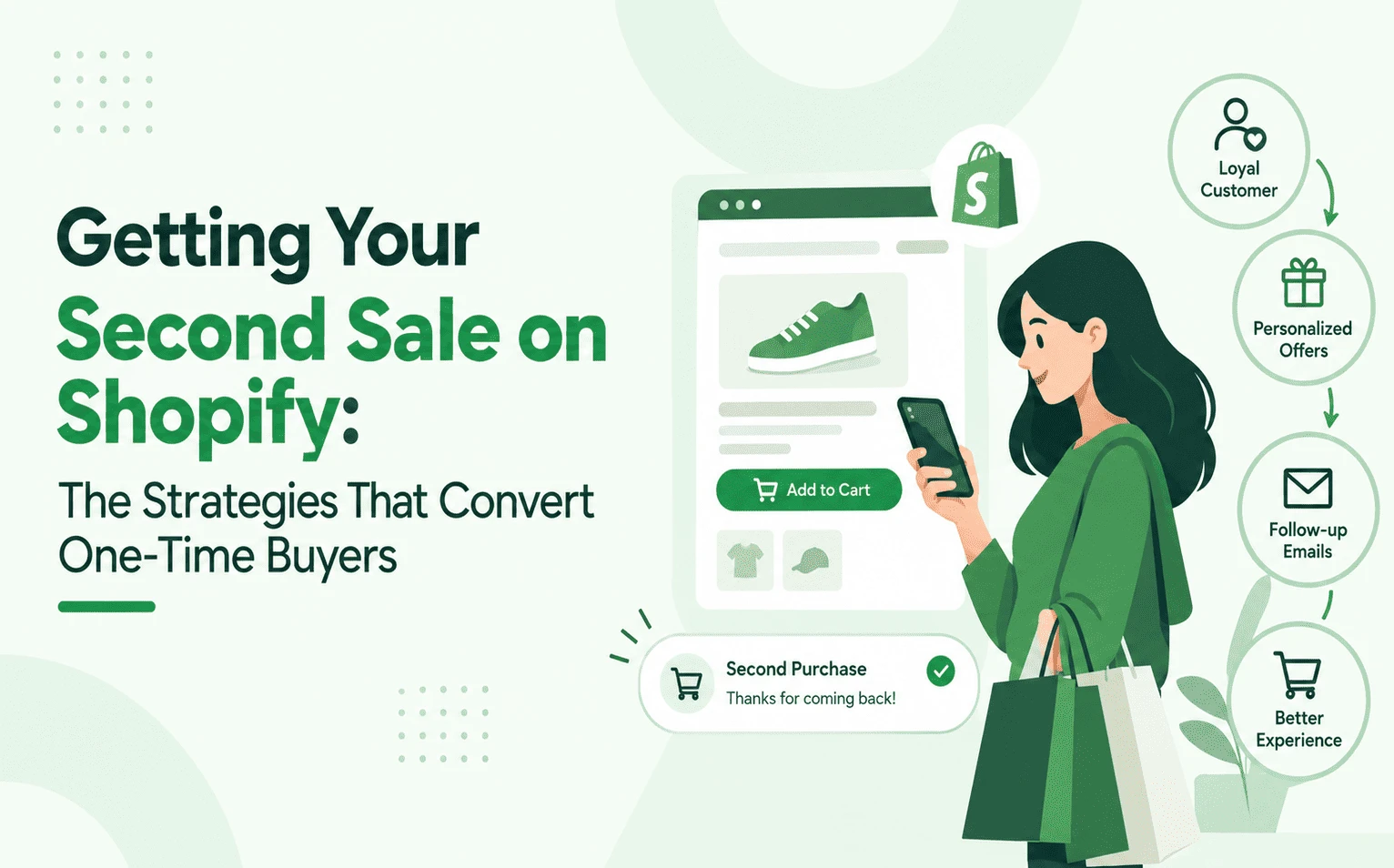
The first order comes in. The confirmation email goes out. The package ships, the customer opens it, and then nothing happens. No second order, no reply to your follow-up email, no sign the customer remembers your store at all.
If this sounds familiar, you are not alone. Turning first-time shoppers into Shopify repeat customers is one of the harder, more overlooked jobs on Shopify. Most merchants spend their time and ad budget chasing new traffic. A more interesting opportunity is often sitting quietly inside their existing customer list. The first purchase only proves someone was willing to buy from you once. The second purchase proves something bigger: that the relationship can become repeatable. That single word is the difference between a store that keeps paying for every sale and one that starts compounding.
Why the second sale is the real test
According to Shopify’s own retention data, the average ecommerce store keeps just 30% of its customers. That means roughly seven out of ten people who buy once never come back. That number is not a reflection of bad products. It is a reflection of how little friction it takes to lose a customer’s attention once the first package arrives.
The first sale only asked for curiosity. Someone saw an ad, read a review, or clicked a link and decided to take a chance. The second sale asks for something harder to earn: memory, trust, and a genuine reason to return on their own. No coupon is forcing the decision. That gap between trying you once and remembering you later is where most Shopify stores quietly leave revenue behind. The acquisition cost has already been paid, and the trust has already been earned once.
Product usage cycles matter here too. A customer who bought a phone case has no obvious reason to come back next week. A customer who bought a thirty-day coffee supply does, if the timing is right. Getting the second sale right starts with understanding when a customer is actually ready to buy again. It is not simply about when it is convenient to email them.
Give them a reason, not just a reminder
Customers rarely return out of loyalty alone. They return because there is a logical next purchase waiting for them. Without one, even a happy customer has no real reason to open your store a second time.
For consumable categories like skincare, coffee, or pet food, that next purchase writes itself: it is simply time to reorder. Other categories need a nudge in a different direction. A customer who bought a dress might want a coordinating accessory. Someone who bought a coffee machine might eventually need filters. A customer who bought a seasonal item might be ready for next season’s version in a few months. Small incentives like quantity-based discounts can make that second order feel like better value than a one-off purchase.
Gifting deserves its own mention, because it is one of the most underused second-purchase triggers in ecommerce. A customer who once built a personalised gift box for a birthday is a strong candidate to build another one for the next occasion. That is especially likely if the first experience felt easy and personal rather than like assembling a spreadsheet order. This is where a build-your-own bundle experience becomes more than a novelty. It gives the customer something to create, not just something to rebuy. The same logic applies outside of gifting too. Letting shoppers put together a custom product bundle, a skincare routine, a snack box, or a baby-care set turns a second visit into a different kind of purchase. That holds true even when it is the same brand and the same catalogue.
Make coming back easier than the first visit ever was
The first purchase happens despite friction, because curiosity carries the customer through it. The second purchase rarely gets that same grace. It can take effort to find the product again, remember what size they ordered, or dig through a cluttered mobile site. When it does, customers quietly buy from whoever shows up next in their feed instead.
Mobile is where this friction shows up the most. A returning customer has to remember your store’s name, search for it, and reload a site that was never designed with a second visit in mind. Every extra step is a chance to lose them to a competitor. A Shopify mobile app builder removes several of those steps at once by giving the store a home-screen icon, saved account details, and real-time product and pricing sync. Reordering then takes a few taps instead of a few minutes.
It does not guarantee a repeat purchase on its own. It simply clears away the friction that stops a willing customer from following through. The same principle applies at checkout. A returning customer who sees a familiar, customized checkout experience with a clear upsell or a small thank-you offer is more likely to complete the order. That beats landing on a generic, unfamiliar page.
Keep the next purchase visible instead of buried
Do not simply ask customers to come back. Give them a specific reason, tied to what they already bought, and put it somewhere they will actually see it.
A skincare buyer can be shown a complementary product a few weeks later. A coffee buyer can be offered a refill right before their supply runs out. A gift box buyer can be invited to build another one for the next occasion on the calendar. On-site tools help carry this weight even when a customer arrives without an email prompting them. A frequently bought together display surfaces the natural next item. A recently viewed products carousel reminds a browsing customer of exactly what caught their eye last time, without them having to search for it again.
Watch the numbers that actually explain retention
Most Shopify merchants track total revenue and new customer count closely. They rarely look at how many customers come back or how long it takes. Three numbers tell that story better than a full dashboard. The first is repeat purchase rate, the share of customers who order more than once. The second is time to second purchase, how long a return typically takes. The third is returning customer revenue as a share of total sales. None of this needs to be complicated. It just needs regular attention, enough to spot which products and customer segments are actually coming back. It also shows which ones are quietly churning out.
A practical second-sale playbook
- Identify first-time buyers and separate them from repeat customers in your reporting.
- Look at what they actually bought, not just how much they spent.
- Work out the most logical next purchase for each product category.
- Give customers a specific reason to return, not a generic reminder.
- Remove friction from the mobile experience, where most return visits start.
- Re-engage at the right time, based on usage cycles, not a fixed schedule.
- Track second-order behaviour on an ongoing basis, not once a quarter.
The opportunity is already in your customer list
Getting more first-time customers will always matter, but it is not the only lever available. Sometimes the more efficient opportunity is already sitting inside a customer list the merchant has already paid to build. A returning customer already trusts the brand and only needs a reason and an easy path to buy again.
Shopify merchants working on this have two practical starting points: a branded mobile shopping experience through a Shopify mobile app builder, or something new to build through a personalized bundle and gift box tool. Neither replaces a good product. Both make it easier for a customer who said yes once to say yes again.
Frequently Asked Questions
Q1. How do I get repeat customers on Shopify? Give customers a clear next purchase, whether that is a replenishment, a complementary product, or a new collection. Then make it easy for them to complete it, especially on mobile. Repeat purchases follow from removing friction and providing a logical reason to return, not from discounts alone.
Q2. What is a good repeat purchase strategy for Shopify? The most effective approach ties a follow-up offer to what a customer already bought, rather than sending generic reminders. Pairing well-timed outreach with an easy mobile path back to the store tends to outperform blanket promotions.
Q3. How can I turn first-time Shopify buyers into repeat customers? Start by tracking what first-time buyers purchase and when they are likely to need something again. Then reduce the steps between deciding to reorder and actually checking out, particularly on a phone.
Q4. Does a mobile app help Shopify customer retention? A mobile app does not guarantee repeat purchases. It does remove common obstacles, like remembering a store’s name or navigating a slow mobile site, that stop willing customers from following through.
Q5. How can bundles encourage repeat purchases? Bundles give customers something new to build rather than the same product to rebuy. A build-your-own gift box or mix-and-match set can turn a returning visit into a fresh experience instead of a repeat transaction.
Related Blogs



 [email protected]
 +91 95747 42204
 9th Floor, Solitaire Connect, Near Gallops Motors, SG Highway, Ahmedabad, Gujarat 380015


